website

Monthly Archive for June, 2011

The Death of Email or Premature Mourning?

Email is dead. Swamped by spam, afraid of phishing, and distracted by the latest social media gimmicks, internet users have abandoned email in favor of instant messaging, Facebook, and Twitter. Or so some websites would have you believe.

WSJ article back in 2009 went so far as to say that email itself was dead.

“Email has had a good run as king of communications. But its reign is over.” – Jessica Vascellaro on WSJ

More recently, OracleDigital made a better case for the death of email marketing with statistics. The claim is that Social Media is rapidly displacing email marketing from its throne. To put it bluntly, email marketing is now a waste of resources, because statistics say so.

“…the average open rate of emails in the USA dropped from 14% in half 2 of 2007 to a humble 11.2% in half 2 of 2009.” – Clint Maher on OracleDigital

Statistics do not lie, surely. Or do they? Let’s find out.

Continue reading ‘The Death of Email or Premature Mourning?’

The Power of Testimonials in Email Marketing


We all know the importance of using customer testimonials on web sites.  People need the security and comfort of knowing that other people have appreciated what you have to offer. This is really a very basic part of any marketing strategy and if you think about it you will also choose to go with a service that other people tried and like rather than opt for uncharted territory.

But can customer testimonials work also in an email marketing strategy?  To answer this question you must put yourself in the shoes of the recipient of your message.

When you use email marketing to spread your message you must remember that you are talking to real people who think and act much like you. If what you have to offer is interesting enough to them, they will most likely search you out by visiting your site or even contact you to learn more. This is the first step, but what will make them go for your service or product wholeheartedly? Real and positive testimonials! This is how the world works. If you need to have your house painted and your says that Willy’s Paint is the best, you will go for it.

Continue reading ‘The Power of Testimonials in Email Marketing’

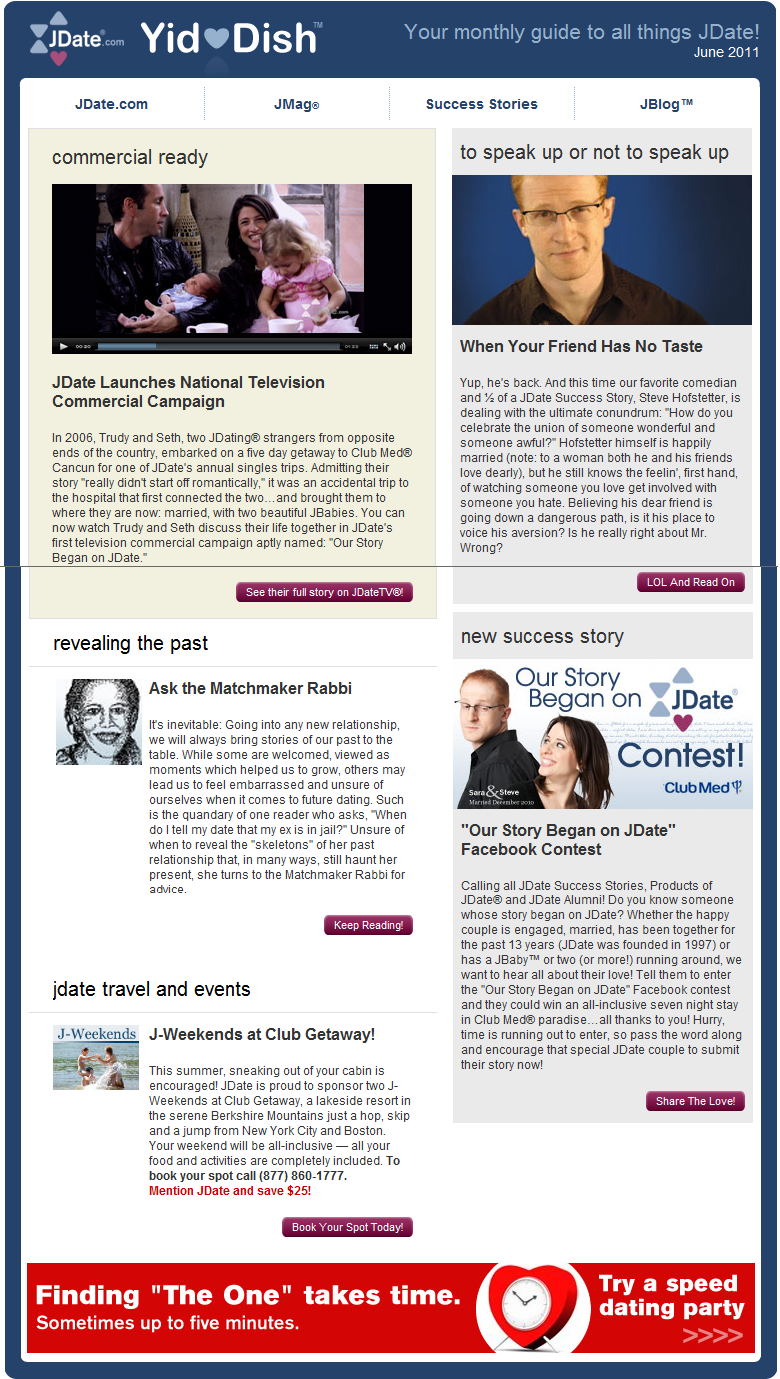
JDate: a Simple Model for an Email Newsletter

Maintaining an email newsletter can be a challenge. Month after month, you have to come up with ideas for content, conduct the research, write the articles, paste them into the template, send them out to your list and monitor the results. It’s one reason that so many firms choose to outsource their newsletters. But the biggest challenge comes before you even begin writing – when you have to produce a structure for the newsletter that can function as the template. It has to be both flexible enough to work over the long term and simple enough to fit into an email’s restricted space.

One solution is to look at how other newsletters are laid out — even those in a different industry — and see what they have to offer you.

JDate, for example, is a niche dating site targeted towards the Jewish community. Each month the site issues an email newsletter that is both simple and effective.

Continue reading ‘JDate: a Simple Model for an Email Newsletter’

Has Social Media Replaced Email Marketing?

Do you worry about lagging behind other companies in the rush toward the social media marketing revolution? Or do you spend so long updating your status, posting, and tweeting that you have little time left to run your business? If we are to believe the hype, email marketing is outdated and a successful marketing campaign revolves around your company’s social media presence. But how true is that for the average business?

Only 5% of visitors to retail websites identify social media as their primary influence, according to a survey published in February 2011 by ForeSee Results, a global leader in technology-driven customer satisfaction analytics. Contrast that with 19% of visitors reporting promotional emails as their primary influence, second only to familiarity with the brand (38%).

Perhaps this should not surprise us when we consider consumer preferences. In a study published in April 2011, AOL and Neilsen identified that 66% of content is shared via email, compared with 28% on social networks. In the ForeSee Results survey, 8% of online shoppers identified social media as their preferred way to interact with a retailer. Promotional emails came out on top with 64%.

Continue reading ‘Has Social Media Replaced Email Marketing?’

Help Create an Email Charter

Is it possible to have a definitive list of common rules for safer and more responsible email usage?
In 2009 Internet marketing guru Seth Godin, posted a long checklist that everyone should run down before hitting “send” on the next mail:

  1. Is it going to just one person? (If yes, jump to #10)
  2. Since it’s going to a group, have I thought about who is on my list?
  3. Are they blind copied?
  4. Did every person on the list really and truly opt in? Not like sort of, but really ask for it?
  5. So that means that if I didn’t send it to them, they’d complain about not getting it?
  6. See #5. If they wouldn’t complain, take them off!
  7. That means, for example, that sending bulk email to a list of bloggers just cause they have blogs is not okay.
  8. Aside: the definition of permission marketing: Anticipated, personal and relevant messages delivered to people who actually want to get them. Nowhere does it say anything about you and your needs as a sender. Probably none of my business, but I’m just letting you know how I feel. (And how your prospects feel)

Now, three years later, Chris Anderson – founder of Future Publishing and curator of the TED Conference – would like to do even more. He asked  anyone to help him create an Email Charter.

Continue reading ‘Help Create an Email Charter’

Email Marketing: Four Email Errors That Can Cost You Subscribers

We all know that email marketing is one of the most effective ways to reach new customers. If you’re not capturing customers’ email addresses and sending them useful information, you’re missing out on sales. But there’s a right way and a wrong way to do email marketing – and many companies do it the wrong way. Here are four of the worst email marketing mistakes companies make – and how to avoid them.

1 – Contacting the Customer Too Frequently or Not Frequently Enough
Some companies make the mistake of sending emails to customers every day, sometimes more than once That’s one of the quickest ways to get a customer to unsubscribe. Most people are flooded with emails and offers, and they’re ready to hit the delete button when your email arrives too often. At the other extreme, some companies capture customers’ email addresses and rarely follow up. Contact the customer too frequently, and you’ll be labeled a pest. But if you rarely send them anything, they may forget they signed-up and think you’re a spammer. For most customers, emailing once or twice a month is reasonable.

2- Trying Too Hard to Sell
Customers hate being sold to. Don’t turn your email into a sales pitch. Provide your customers with useful information and a link to your site. Give them something of value, and they’ll look forward to your emails – and you’ll be rewarded with repeat business. Ask yourself what of value you can offer your customers instead of thinking in terms of what you can sell them. They’ll love you for it – and it’ll show in your bottom line.

Continue reading ‘Email Marketing: Four Email Errors That Can Cost You Subscribers’

This post is part of a series of guest posts authored by popular bloggers and internet business consultants. Today's guest post is written by Daniela Baker, who helps entrepreneurs at CreditDonkey with evaluating the best credit card for small business.

How to Keep Your Email Campaign Out of the Spam Folder

The spam folder—every email marketer’s worst nightmare. Once your emails are flagged as spam, your campaign metrics plummet, going from a potential success to an email flop. Thankfully, there are some tactics you can employ to help ensure your emails stay in your recipients’ inbox instead of their spam folder.

Here are the tips you can follow to keep your email campaign out of the spam folder.

Follow the CAN-SPAM Act

Whether or not your emails are getting sent to the spam folder, it’s important that you follow the CAN-SPAM Act. It’s a federal mandate that email marketers must follow. Included in the act are the following points, as outlined by the Federal Trade Commission:

  • Don’t be misleading or use false information in the header (“To” and “From” fields)
  • Skip the deceptive subject lines
  • Clearly identify the email as an advertisement
  • Include your business mailing address (this can include a P.O. Box)
  • Include opt-out instructions for future e-mails
  • Follow-up on opt-out requests in a timely manner; opt-outs must be processed within 10 business days

Also, it is important to note that you’re responsible for all email marketing efforts completed for your business. This includes email marketing that you pay another firm to complete for your company. This makes it important for you to do your due diligence and monitor any efforts that are being completed on your behalf.

Continue reading ‘How to Keep Your Email Campaign Out of the Spam Folder’


Load Times Plugin made by Cheap Web Hosting