website

Monthly Archive for August, 2011

Happy 28th Anniversary Email!

It was 28 years ago today, Aug 30th 1978, when a 16 18 year old guy named Shiva Ayyadurai copyrighted “EMAIL” along with terms like “To: From: Cc: Bcc: Subject: Reply, Reply All, Forward”.
The two words, “Electronic” and “EMAIL” – says Shiva – juxtaposed together for me originally brought images of vaporizing paper and somehow transporting it across electrical wires, like the transporter in Star Trek.

Here’s the Certificate of Copyright Registration that Shiva submitted to the US Copyright Office :


Today, 28 years later, Shiva is teaching a class at MIT called “Systems Visualization,” and he believes future is still looking good for email: “I think email has a very particular purpose and I think it’s going to grow in that…Web mail might decline but devices will still access people’s email communications. Facebook may do some integrated email but fundamentally it will be email”.

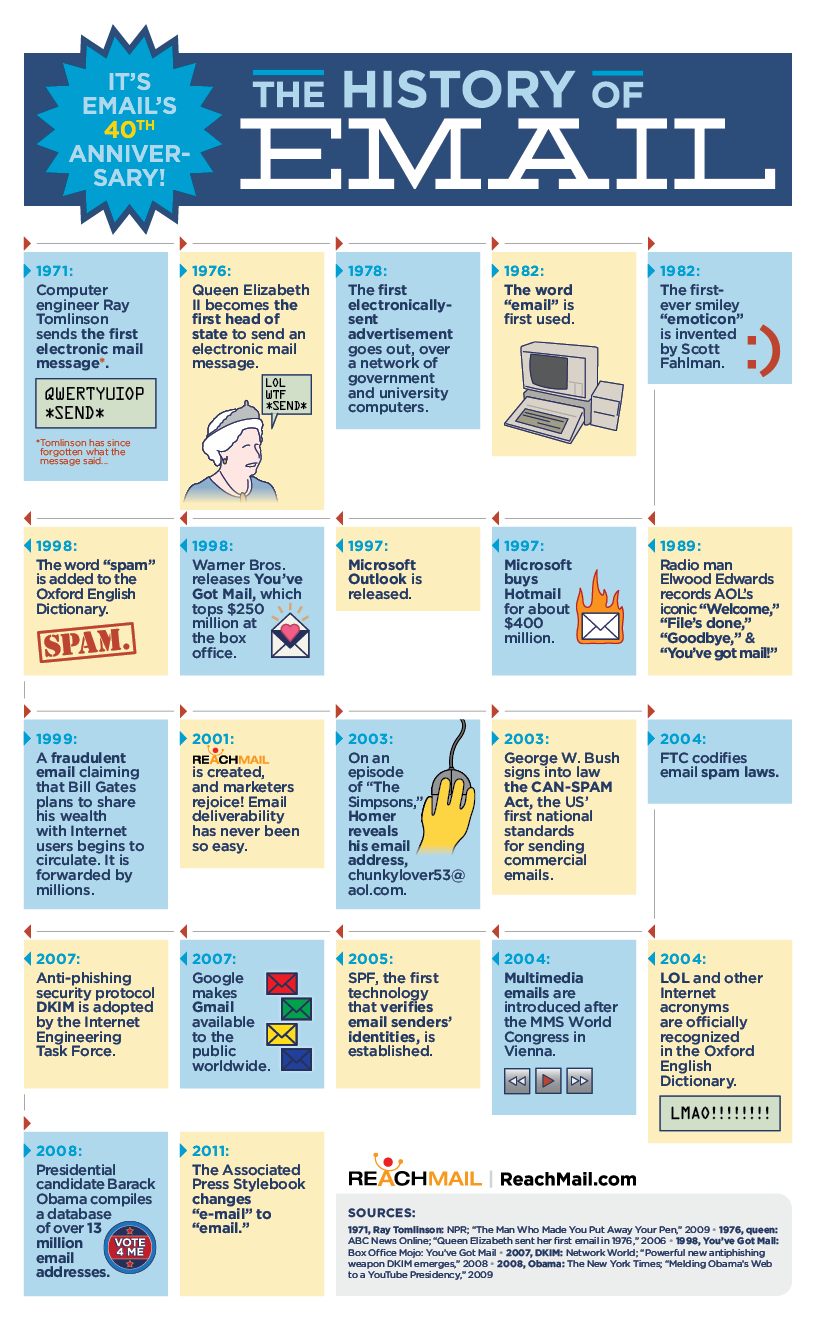
On the occasion of the 28th Anniversary of EMAIL, Shiva designed an awesome infographic depicting the History of Email and Growth of Email Accounts. A must see for everyone!

(Click the image to enlarge)

Keywords that Make your Newsletters Pop

On the Web, keywords are vital. They ensure that sites are listed by search engines, delivering the right kind of free traffic, and they help Web pages make money by serving relevant ads. For newsletters, keywords are no less important, but they’re vital in a different way: while site-based keywords are read by computers which focus on the terms not the context and deliver a measurable result based on an algorithm, newsletter-based keywords are read by humans and the effect is simpler than any math-based code can deliver. Either the keyword evokes interest in a subscriber and prompts him or her to read, or it doesn’t.

That human reaction makes newsletter keywords much easier to both choose and use. Creating a list of keywords that should prompt a response from subscribers is relatively simple. Your site statistics will tell you which terms were used by visitors who reached your newsletter sign-up page from a search engine. Include the most popular of those terms in your newsletters and readers who see them will feel that they’re getting a message that’s important to them.

Continue reading ‘Keywords that Make your Newsletters Pop’

17 Effective Ways to Grow Your Opt-in Subscriber List

Your opt-in subscriber list is the foundation for your email marketing campaign. No matter how interesting your content and compelling your call to action, your email marketing campaign cannot be successful without a sizeable list of interested recipients.

Follow these 17 tips to grow your opt-in subscriber list.

Keep It Short & Simple

1. Keep your opt-in form short and simple. Capture only essential information, such as the user’s name and email address. Add an optional second stage if you want collect further details.

Make It Obvious

2. Every page of your website should display your opt-in form. Place it at the top of the right-hand sidebar, above the fold, for maximum effect.

3. Give users a nudge by displaying your opt-in form on a pop up. Although some web users find them intrusive, marketers continue to use them because they are an effective way to increase subscriptions.

4. Include a sign-up request in the “About the Author” paragraph at the bottom of your blog.

Continue reading ’17 Effective Ways to Grow Your Opt-in Subscriber List’

Email Marketing: A Vital Tool for Non-profit Organizations

Online fundraising rose by 40 percent between 2009 and 2010, making it the fastest growing fundraising channel for nonprofit organizations, according to the annual Convio Online Marketing Nonprofit Benchmark Index™ Study.
With the 600 respondents raising more than $1.3 billion online during 2010, the study makes it clear that supporters increasingly want to engage with nonprofits electronically.

Email marketing has become a vital tool for nonprofits. On average, nonprofits had almost 50,000 subscribers on their email databases in 2010, an increase of 22 percent over 2009.

For cash-strapped nonprofits, emails are more cost-effective than printed material, with each email costing a few cents to create and send. Many nonprofits have embraced email marketing and are engaging subscribers more effectively than their commercial counterparts.

Continue reading ‘Email Marketing: A Vital Tool for Non-profit Organizations’

Engage Your Subscribers by Inviting Them to Work for You

A marketing email should do one of two things. It might drive immediate sales with a special offer, a strong call to action, and a sense of urgency that forces readers to push the button now. Or it might build a relationship by providing valuable news and information that enables subscribers to understand that yours is the business of choice in your industry.

Those kinds of emails might prompt few immediate sales but they do drive your brand deeper into the minds of your market and generate future sales. One way to create those kinds of messages – and pick up some valuable information of your own – is to turn your prospects not into customers but first into staff.

For software firms, that usually means advertising for beta testers. Those testers aren’t just a large, no-cost QA team; they’re also a market that’s getting a free sample of a product that they should find invaluable by the time it’s ready for general release. Send an invitation by email to be a beta tester and your subscribers will feel part of a special crowd. They’re getting a sneak peek at an important new product. No less importantly, they’ll realize that the emails they receive from your firm contain more than invitations to buy; they also contain opportunities – and that makes them all more likely to be read.

Beta testing doesn’t suit every company but any firm can also use its subscriber base to ask for advice. All business decisions involve taking risks but when you have a list of potential buyers, you also have a way to reduce those risks. When you’re divided between two features, for example, you can ask your subscribers which they’d like to see developed. Or you can leave the question more open and simply survey your readers about needs that they feel aren’t being met.

Continue reading ‘Engage Your Subscribers by Inviting Them to Work for You’

How to Destroy your Email Program

Do you want to destroy your email program? Just follow these 5 “explosive” tips suggested by email expert Andrew Kordek.

The History of Email [Infographic]

Happy 40th Anniversary, Email!


Load Times Plugin made by Cheap Web Hosting